Friendship Skills: Helping Your Child Make FriendsFriendship Foundations: Teaching Kids to Connect, Empathize & Belong
By Jean Tracy, MSS
Friendship skills give your child exactly what he wants – FRIENDS!
Children without friendships can experience sadness, confusion, and loneliness. Because a great many youngsters lack the skills to make friends, they may act bossy, brag, or feel shy. You might hear them yelling, arguing, or not knowing what to say when they're with other kids.
Imagine a boy too shy to talk, a girl at recess walking by herself, or a child whose only friend has moved away. I know these children. They are real.
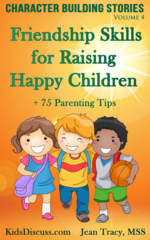
As a mother, a former teacher, and family counselor, I've searched for friendship skills to help children of all ages. My kindle book, Character Building Stories: Friendship Skills for Raising Happy Children + 75 Parenting Tips is the result.
How Parents Can Help Children Boost Friendships
- Read each character-building story with your child.
- Discuss the social skill within each story. Listen to your child's ideas.
- Role-play the skill with them, and then encourage them to practice it at school.
- Use a calendar to track progress.
- Deepen the skills by asking your child to draw and add captions for each character in the before and after scenes.
You'll find parenting tips for furthering the friendship skill at the end of each story. Each of the 20 stories includes a friendship technique like:
- Lazybones Larry's Pitch-In Principle
- Noah's Smiley-Face Notebook
- Invisible Izzy's Name-and-Smile Solution
- Rita's Repetition Response
- Shy Nate's If-Then Formula
The Stories Teach Your Child to Be Friendly by:
- Listening and relating to the story character's problem
- Understanding the character's feelings
- Discovering the friendship skill for solving the problem
- Seeing how the character uses the skill
- Discussing the story with you and choosing a friendship skill to practice
You examined why many children struggle to make friends and how lacking social skills can lead to lonely or awkward interactions. You went through storybased techniques including reading, discussion, role play, and tracking progress—each designed to help your child practice kindness, listening, relating, and empathy in real social settings. You noted how the stories prompt dialogue between you and your child, helping them internalize friendship principles. Armed with these tools, you can now guide your child to become more socially confident, relationally aware, and genuinely connected with peers.