How Parents and Kids Conquer Fear - A Powerful Technique
By Jean Tracy, MSS
Imagine fear invading your mind like a virus. It infects your mind with thoughts. It’s all you can think about.
- Will I get sick?
- Will my kids get sick?
- What about my job?
So many thoughts recycling over and over that you:
- Forget what you’re about to do.
- Talk harshly.
- Make mistakes.
- Feel tight inside.
- Forget to breathe.
Now imagine your child watching you. She’s seen the news. She’s aware that things are bad and wonders:
- Am I safe?
- Will my parents protect me?
- What will happen to my family?
Fear has infected her too.
One big difference between you and your child:
You’ve battled difficult situations and painful feelings many times in your life. You are a mind warrior because somehow, you’ve come through.
Your child is much less experienced than you and lacks the mental weapons you possess, even if you don’t know you possess them.
Remember this. It’s the frightful thoughts that wage war in your mind and cause your fear. You’ve battled them before. How will you deal with them now?
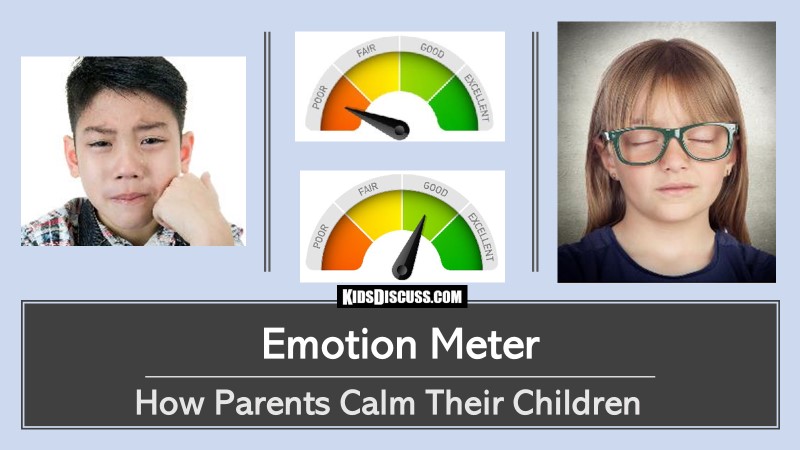
Today I’ll share the Emotion Meter (Sometimes called the Mood Meter) to use personally and then with your child. Use it as often as needed. Be a warrior again and teach your child to be a warrior too.
How to Use The Emotion Meter to Lesson Your Own and Your Child’s Anxiety:
- Make sure your child is in a good mood before you start.
- Talk privately.
- Discuss out-of-control feelings like fear.
- Ask, “Would you like to replace fear with a better feeling?”
- Say, “What feeling would you like to have instead?”
Your child might answer with one of the following or something else.
- Confidence
- Peaceful
- Calm
- Secure
- Brave
Ask Your Child to Draw the Emotion Meter
- Draw an arc
- Evenly divide into four parts
- From left to right label the parts into Poor, Fair, Good, Excellent
- Add a needle in the center to use as a pointer
In Your Calm Voice Speak Peacefully and Say:
“Close your eyes. (Pause 5 seconds for your child to focus. Then use the following script. Go slow.)
“Take 3 deep breaths. (Pause 5 more seconds.)
Tell your child, “Imagine the feeling you’d like to have.”
“Picture your good feeling at ‘Poor’ on your meter. Take all the time you need. Nod your head to let me know you’ve done it. I’ll be quiet and I’ll be here if you need me.”
(After she’s nodded, continue.)
“Move the needle and your good feeling higher on your meter. Take all the time you need. Nod your head to let me know you’ve done it.”
(After she’s nodded, continue.)
“Move the needle up again.”
“You CAN change the feeling.” (Pause 5 seconds.)
“Your powerful mind is moving the needle up. Nod your head to let me know you’ve done it. Take all the time you need.”
(After she’s nodded, continue.)
“When your dial is ‘Good’ or higher, nod your head to let me know you’ve done it. Again, take all the time you need.”
(After she’s nodded, continue.)
“Open your eyes. Where is your needle now?”
“Repeat until the needle reaches “Good” or “Excellent.”
Assure your child, “No matter how bad the feeling is, her brain’s powerful imagination can make it better.” Advise her to use her Emotion Meter often. Or better yet, let her know she can do it with you again and again whenever she needs it. Tell her, “Just ask me.”
Conclusion for Conquering Fear and Anxiety
When you, parent, feel the signs of fear taking over your mind, become a mental warrior. You’ve done it before. You can do it again.
Notice your child. Are there signs fear? Is your child too quiet, breathing shallowly, or acting distracted and cranky? Teach the Emotion Meter. If you do, you’ll be teaching your child an important life skill: how to be a mental warrior.
Watch and discuss this video, How Parents and Kids Discuss Emotions, with your children. It will reinforce your efforts to teach the Emotion Meter and calm them down.